
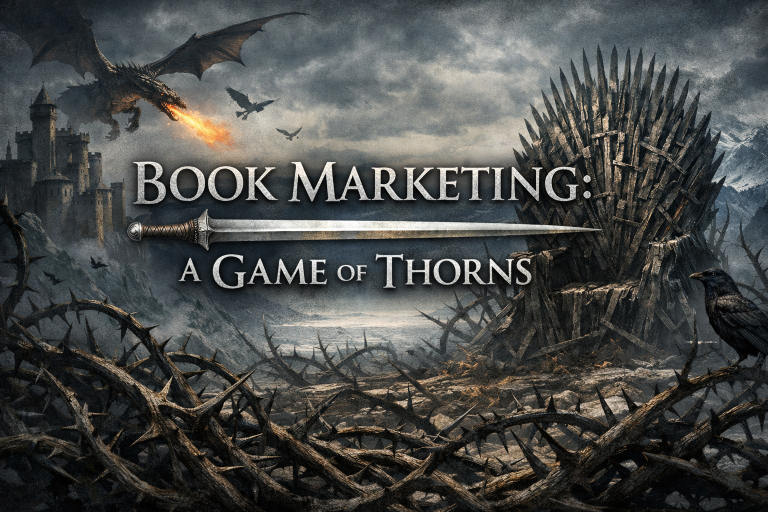
Book marketing on social media is not a ladder. It is not even a path. It is more like a thorn hedge that shifts position while you are trying to push through it.
Every author enters with the same hope. Write something good, tell people about it, watch readers arrive. What actually happens is messier, stranger, and far more humbling.
One day a carefully crafted post about a novel you poured years into sinks without trace. The next day, an offhand remark typed before breakfast reaches tens of thousands of people. No sales. No follows. Just eyes, briefly pausing, then moving on.
And that is where the first thorn lies.
Attention is not interest
Social media rewards interruption, not intention. A post that stops the scroll has done only half the job. The other half, the harder half, is turning that pause into curiosity about you.
An image can go viral and leave nothing behind. A joke can land and be forgotten. A moral question can travel widely and still produce silence afterwards. None of these outcomes are failures. They are simply different forms of attention.
Authors often confuse impressions with progress. They are not the same thing. Progress shows up quietly in profile visits, bookmarks, and the occasional message from someone who says, “I looked you up.”
Those are the real signals. Everything else is noise.
The algorithm does not love your book
Another thorn is believing the platform owes you something.
It doesn't care how long your book took to write. It doesn't care about your research, your edits, your rewrites, or the nights you kept going when quitting would have been easier. The algorithm rewards what keeps people on the platform, not what deserves to be read.
This is not cruelty. It is design.
Once you accept that, marketing becomes less personal. You stop asking, “Why didn’t this work?” and start asking, “What made people pause?”
That shift matters.
Curiosity beats persuasion
Direct selling is brittle. Curiosity is elastic.
Most people don't come to social media looking for books. They come for distraction, connection, or reflection. When an author tries too hard to persuade, the thorns push back.
Curiosity works differently. It asks questions rather than making claims. It invites thought instead of demanding action. It leaves space for the reader to step forward on their own terms.
A line that makes someone think, “That’s interesting” will always outperform a line that says, “Buy my book.”
Not because the book lacks value, but because curiosity opens the door, whereas persuasion slams it shut.
Humanity outlasts strategy
There is a final thorn that catches many writers. Trying to be a brand before being a human.
Readers do not follow logos. They follow voices. They stay for honesty, humour, doubt, persistence, and small truths shared without agenda.
When you talk about writing struggles, early mornings, failures, odd observations, or moral discomfort, you are not wasting marketing space. You are building context. When a book finally appears in that space, it feels earned rather than imposed.
Books do not sell because they are announced. They sell because trust has already been built.
Walking the hedge
Book marketing on social media is not about mastery. It is about tolerance for uncertainty.
Some posts will bloom unexpectedly. Others will vanish. The trick is not to chase the thorns, but to keep walking, observing what catches and what slides past.
Curiosity opens doors. Humanity keeps them open. And patience is the only glove thick enough to handle the hedge.
Copyright © Brittle Media Ltd 2026-2027
Brittle Media Ltd.
128, City Road, London, EC1V 2NX, England.
Company Registration Number: 16668227

Notes from the Indie Trenches
Essays from fifteen years in the indie trenches