Indie Audience: Who am I writing and publishing for?
One of the most common questions new writers ask is also one of the most dangerous.
“Who is my audience?”
It sounds sensible. Professional, even. But asked too early, or answered too rigidly, it can do more harm than good. It can freeze the voice, flatten the prose, and turn writing into an exercise in second guessing an imaginary reader who does not yet exist.
For an indie author, the better question is quieter and more honest.
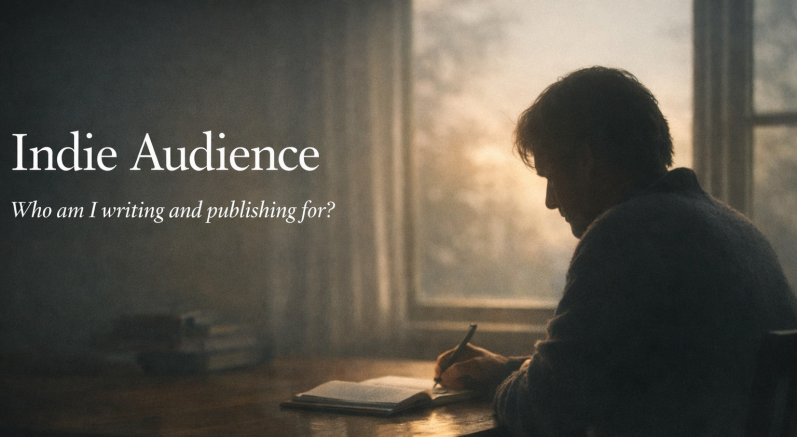
Who am I writing for right now?
The imagined crowd
Traditional publishing trains writers to think in terms of demographics. Age bands. Genres. Market segments. Comparable titles. Shelf placement. All of that has its place, but for an independent author working alone, often in the early hours of the morning, this way of thinking can become paralysing.
You begin to write with a crowd in mind. A room full of opinions. Invisible editors. Algorithmic expectations. You hesitate. You soften a sentence. You remove something strange or personal because it might not “work”.
That is how originality quietly dies.
Most readers are not looking for perfection. They are looking for recognition. A sense that the voice on the page is real.
Writing for one reader
In practice, most successful indie authors do not write for thousands of people. They write for one.
Sometimes that reader is themselves, a few years ago. Sometimes it is a younger version who needed a book like this and could not find it. Sometimes it is a friend, a partner, or a reader who once sent a message saying, “This meant something to me”.
That single imagined reader becomes an anchor. Not a market, but a human being.
When you write for one person, your voice steadies. You stop performing. You start telling the truth as clearly as you can.
Paradoxically, this is how you reach many.
Publishing is a different act
Writing and publishing are often confused as the same thing. They are not.
Writing is private. Publishing is public.
As an indie author, you are allowed to separate them.
You can write without compromise and then publish with care. That is where audience awareness belongs. Not in the sentence level decisions, but in how you present, describe, and position the work once it exists.
Blurb, category, keywords, cover, pricing. These are conversations with an audience. The manuscript itself should not be.
This distinction protects the work.
Let the audience find you
Indie publishing reverses the old model. You are no longer trying to please a gatekeeper in the hope of being allowed through. You are placing a signal into the world and seeing who responds.
Over time, patterns emerge. Certain books find certain readers. Certain themes resonate. You notice who writes back, who subscribes, who follows quietly for years.
That audience is discovered, not designed.
And it is often smaller than you think, but far more loyal.
Writing as an act of alignment
The most enduring indie careers are built not on chasing audiences, but on alignment.
Writing what you genuinely care about.
Publishing it consistently.
Speaking honestly about why it exists.
Readers who share that frequency will find you. Others will not, and that is fine.
You are not writing for everyone. No one ever is.
You are writing for those who recognise themselves in your work, even if they cannot quite explain why.
The quiet confidence of independence
There is a deep confidence in knowing that you do not have to bend your voice to be heard.
As an indie author, your audience is not a target. It is a relationship that forms slowly, book by book, word by word.
Write the book only you could write.
Publish it with care.
Then let it go.
The right readers will arrive in their own time.
Copyright © Brittle Media Ltd 2026
Brittle Media Ltd.
128, City Road, London, EC1V 2NX, England.
Company Registration Number: 16668227

Notes from the Indie Trenches
Essays from fifteen years in the indie trenches
Indie Audience: Who am I writing and publishing for?